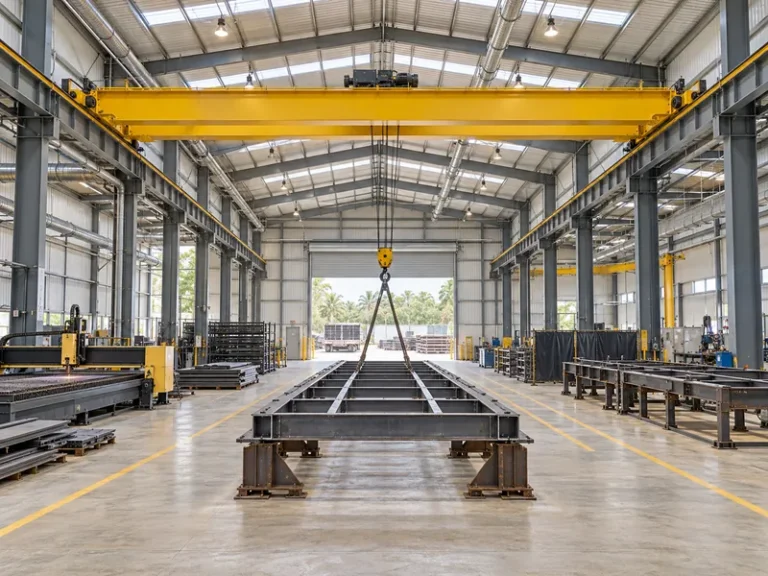
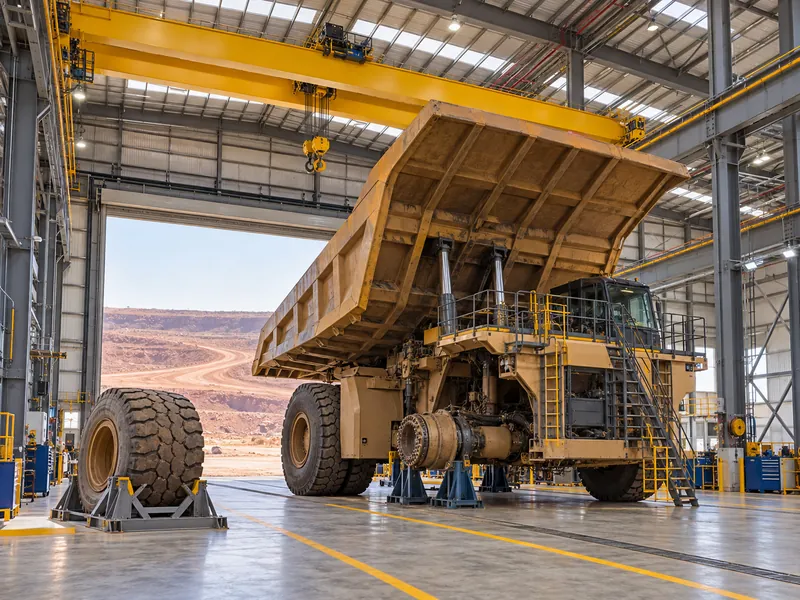
A mining equipment maintenance workshop building is sized by the fleet it keeps running, not by a floor area chosen in advance. The bay count, door openings and crane envelope of this steel frame structure workshop all follow from three fleet facts. Which machines come in? What is the largest whole-machine envelope? How many units are down at once when planned services and breakdowns overlap? Without those answers, every dimension is a guess that the first oversized truck will test.
This guide is for mine owners’ engineering teams, EPC managers and local contractors preparing a fixed maintenance base in markets such as Burkina Faso, Peru, Zambia and Ghana. It covers the building side: fleet bays, envelopes, slab and frame loads, and the interfaces for washing, hot work, tires and testing. Mining production equipment, crane or wash-plant selection and local approvals stay with the equipment owner, the specialist suppliers and the local authorities.
Mining Equipment Maintenance Workshop Building Requirements
Every later dimension inherits from the fleet list, so the requirements start there. The list should name each machine class that will enter the shop: haul trucks, loaders, dozers, graders and support vehicles. For each class, give the number of units, the OEM dimensions and the work done inside, whether routine service, component change, inspection, tire change or welding repair.
Bay count follows the peak number of machines down at the same time, not the size of the fleet. Planned services can be spread across the roster; breakdowns cannot. The two peaks stack when a scheduled service window meets a run of unplanned failures. The owner’s maintenance planner holds the inputs: service intervals, typical repair durations and the availability target. From these, the planner should state how many units the shop must hold under cover at once and how many may wait in the yard. This guide gives no fleet-to-bay ratio, because the number has to come from the owner’s own maintenance data.
Whole-machine entry separates mining workshop design from industrial equipment maintenance workshop building design for plant machinery, where repair usually centers on parts brought to a bench or stand. In a mining shop the machine drives in under its own power. The largest unit therefore sets the door opening, approach apron, turning space and bay length, and major components come off inside the bay where the machine stands. Draw the largest machine’s swept path from the haul road to its bay before fixing any gridline. For whole-boat access into a shore-side hall, marine repair workshop steel building design follows the boat-and-support envelope through the layout.
Whole-Machine Bays, Removed Components and Mine Yard Queues
Three kinds of space compete in a mining workshop: bays for whole machines, floor for stripping or staging removed components, and yard space for machines that queue or wait for parts. Treat them as one undivided floor, and a component ends up in the path of a truck reversing out of the next bay. Removed engines and other major assemblies need a laydown area within crane reach and a route out that does not cross a machine path.
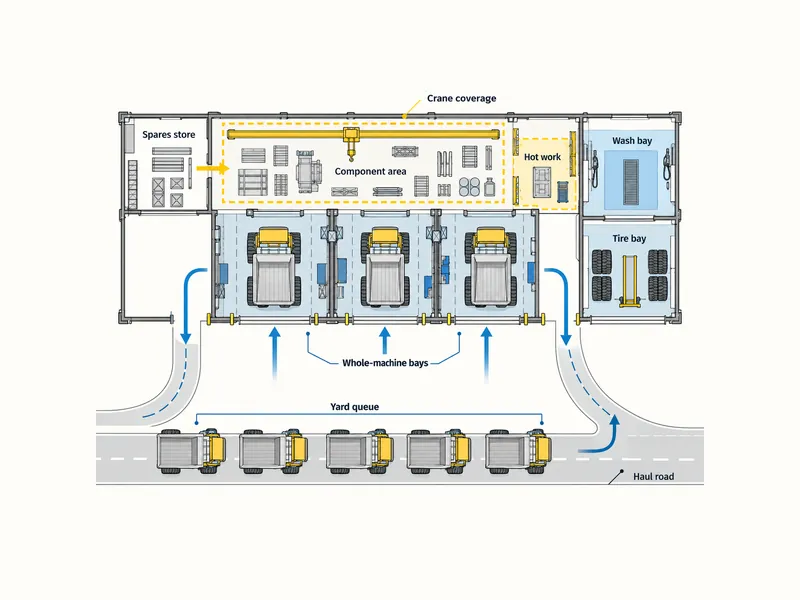
Traffic around the building is a safety question as well as a layout one. Western Australia’s mine workshop audit template asks whether traffic flow has been considered in relation to the building. The NSW Resources Regulator lists machinery coming in and out of the area among service bay hazards. For the steel kit, the answer decides whether machines drive through, reverse in or use separate entry and exit doors. That choice fixes door positions on the frame and the apron and queue layout outside.
The split between site repair and off-site rebuild changes the size of the component area. Some equipment service providers run component rebuild workshops away from the mine sites. The owner should therefore state which assemblies are repaired at the base and which are swapped and sent out. A base that rebuilds major components needs a larger component zone, more crane coverage over it and a cleaner assembly area than a base that only exchanges them.
The general rules of steel workshop design still apply: zone the work, route the materials, then fit a column grid that stays out of the working areas. In a mining shop the zones come from whole-machine envelopes and component flows, so the designer checks the grid against the largest machine in its bay and the crane path over the component area.
Pit, Lift and Crane Envelopes in a Mining Maintenance Workshop
Clear height in a mining shop is the larger of two separate envelopes, and both belong on the same cross-section. The machine envelope is the tallest unit in its tallest service position, for example with a dump body raised for access, plus any jacking. The crane envelope is the hook height needed to lift the tallest component clear of the machine. It adds slings, lifting beam and the crane’s own depth to the rail and roof structure. Whichever envelope is higher sets rail and eave height. OEM data and the crane supplier provide the values, not a rule of thumb.
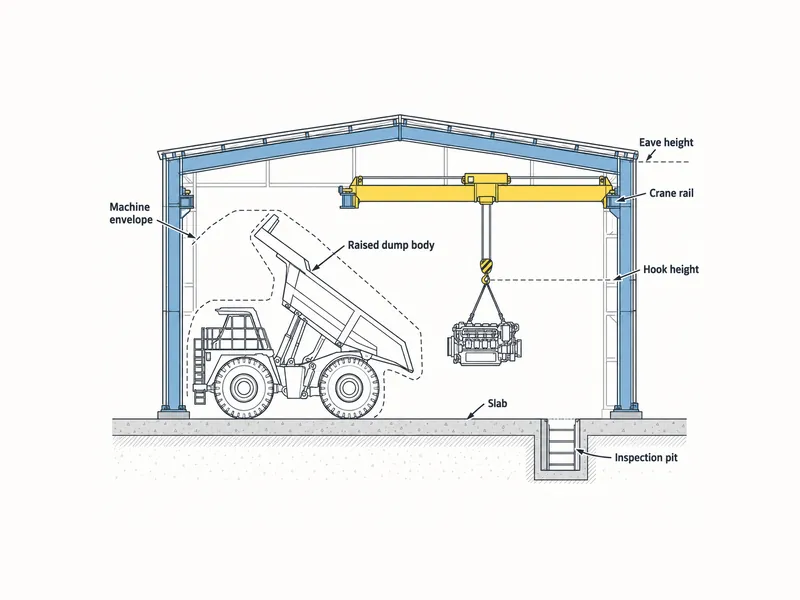
Low-level access is a third envelope, below the floor. Inspection pits change the slab and foundation design, the drainage and the way machines sit in a bay. Western Australia’s audit template expects inspection pit areas to be covered or protected by barriers, and the NSW regulator lists service pits among service bay hazards. The owner decides whether a bay uses a pit, a raised platform or jacking on the slab. The pit itself is local civil work, designed together with the foundations.
Cranes have their own designers, and the building has to receive them. The WA audit template asks that monorails and overhead cranes be designed and constructed to recognized engineering standards. In an export kit quote the crane is a supplied item and a crane rail system is an option. The RFQ should give the rated capacity, span, required hook height, wheel loads from the crane supplier and the bays each crane must serve. The quote should then state how the frame carries those crane loads.
Mining Truck Axle Loads, Slab Design and Frame Reactions
Machine wheel loads go into the slab, not into the steel frame. A mining shop floor carries loaded axles, jacking points, stands under raised machines and heavy components set down for stripping. Western Australia’s mine workshop audit template asks whether the workshop has a concrete floor with known load limits. The local engineer should therefore state slab capacity as a design value and check it against the owner’s axle and point loads.
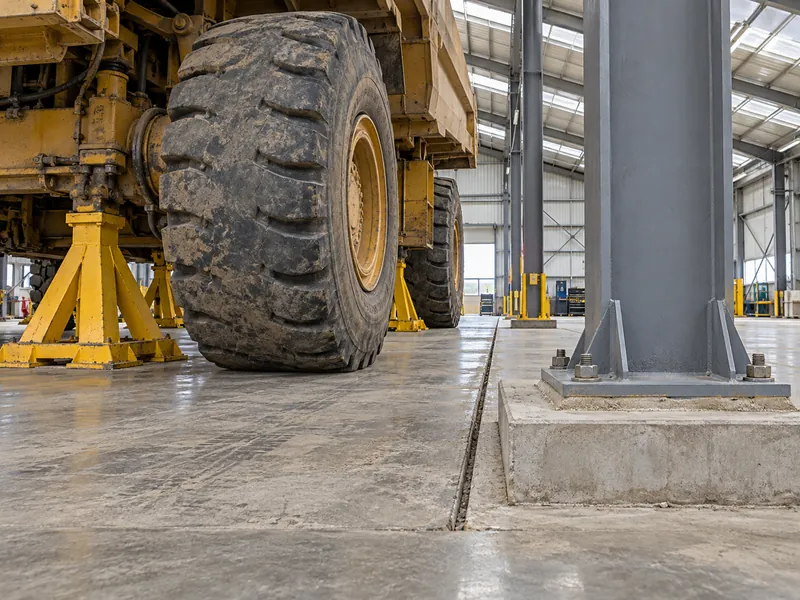
Keeping the slab and the frame as separate load paths is a basic division in metal building architecture. The steel frame takes roof, wall, wind and any frame-mounted crane loads down to its column bases. Machine and jacking loads stay in the slab and the ground below it. Each load has a named owner. The equipment owner or OEM provides axle loads and jacking or stand point loads. The buyer’s local structural engineer designs the slab, pits and foundations to local practice, using the column base reaction data the kit manufacturer supplies. The kit supplier designs the frame to the loads and design code set for the site, and the quote confirms whether anchor bolts are included. A missing input usually surfaces at the foundation stage, when the engineer has to redesign the slab or column bases around late data.
Mining Maintenance Workshop Design for Wash, Hot Work and Tire Bays
Sound mining maintenance workshop design gives washing, liquids storage, hot work, tire changes and testing their own defined areas. Each brings a specialist system that the building must make room for but does not supply. The table below maps each task to the building interface to settle, the buyer’s RFQ input and the party that sets it.
| Maintenance task | Building interface to settle | Buyer input for the RFQ | Set by |
|---|---|---|---|
| Washing before repair | Drains and pits that capture contaminated wash water for treatment, covered or protected | Wash location, drainage and treatment concept | Local civil and environmental specialists |
| Oils and chemicals | Bunded storage for liquid containers; drip trays where liquids are decanted | Storage positions on the block plan | Owner’s HSE team and local specialists |
| Welding and hot work | Structure kept out of the welding return circuit; screens against arc flash; fume extraction | Hot-work zone, extraction routes, roof or wall openings, loads hung from the frame | Welding, electrical and ventilation specialists; openings confirmed in the quote |
| Tire and rim changes | Dedicated bay or designated area; purpose-built handling machinery; stand-off inflation | Tire bay location, handler size and turning space | Owner and tire service provider |
| Testing after repair | No building rule set in this guide | Test type, location and any space or separation needs | Owner and the relevant specialist |
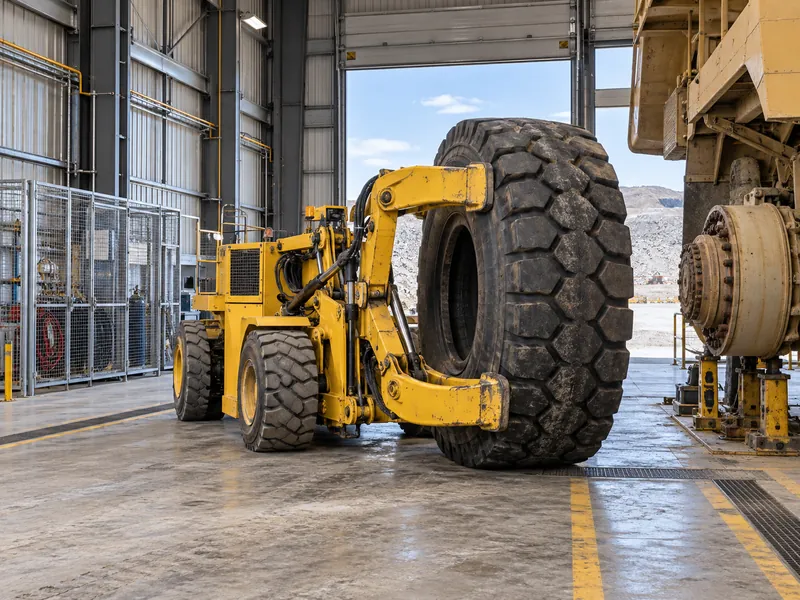
Tire work belongs on the block plan rather than in whichever bay is free. The NSW Resources Regulator’s 2025 workshop hazards guidance states that maintenance workshops must have properly set up bays or designated areas for tire and rim changes on heavy earthmoving machinery. Western Australia’s template adds that large mobile equipment tires are handled with machinery designed for the purpose. The tire bay has to fit the handler and its turning space, not only the wheel.
Hot work needs the earliest decision because it reaches into the steel. WA’s audit template asks that the building structure not be used as part of the welding return circuit, and that welding screens and fume extraction be provided and used. Extraction ducts, screens or hoists may hang from the frame. If so, their positions and weights belong in the RFQ so the frame design can allow for them; the systems themselves come from the specialists.
Post-repair testing may need floor space, exhaust handling or separation from other bays, but those needs depend on the machines and the owner’s procedures. The Western Australian and NSW documents quoted above are reference practice from Australian regulators, not legal requirements in Burkina Faso, Peru, Zambia or Ghana. The owner’s local team confirms local approvals and environmental conditions.
Phased Expansion, Spares Store and RFQ Checks for a Mine Workshop
The quote for a fixed mining base should include its growth path, because a fleet that grows or changes class changes both bay count and envelope. The RFQ should say whether a later phase adds bays at one end, adds a parallel span or adds a separate wash or tire building. That tells the frame designer which end wall, gridlines and crane runway must be ready for extension. Whether to phase at all stays the owner’s decision, tied to the mine plan.
The spares store is an interface to fix early. Its position decides how far major components travel to the bays and whether a crane or a forklift moves them. That in turn sets door positions and the route through the component area. The internal storage layout is a separate brief under mining spare parts warehouse design; the workshop RFQ only needs the store’s location, the transfer route and the connecting door. Inside that store, mining spare parts warehouse design works best when the owner groups stock by what a missing part would stop, not by how fast it moves, and gives repair returns their own zones from the first sketch.
Quote scope for an export kit is narrower than the whole workshop, and the RFQ should reflect that. Xinguangzheng’s kit quotes cover the steel structure, roof and wall panels, gutters and downpipes, bolts, accessories, shop drawings, an installation manual and export packing. Insulation, crane rail systems and on-site installation guidance are options. The quotes exclude foundations, site installation, freight, customs clearance, duties, taxes, insurance, inland transport, permits and site preparation. Cutting starts only after the buyer confirms the Tekla 3D model. Xinguangzheng quotes building projects from 3,000 m² (about 32,300 sq ft), so a fixed base of that size fits its scope and a small temporary shed does not.
Local procurement rules can change who supplies which part of the scope. For Ghana, the International Trade Administration notes that local content regulations set procurement targets for local goods and services in mining, and that localization rules change frequently. The owner should confirm what must be sourced locally before splitting the package between an imported kit and local contractors.
A complete RFQ for the workshop carries five inputs:
- Fleet and downtime strategy: machine classes, unit counts, planned and breakdown peaks, and the number of units held under cover at once.
- Largest whole-machine and component dimensions, including tallest service positions, taken from OEM data.
- Axle loads, jacking and stand point loads, and crane data covering capacity, span, hook height and wheel loads.
- A bay block plan showing whole-machine bays, component areas, wash, hot work, tire and test zones, the spares store and the yard queue.
- Site location, the fixed-base floor area (3,000 m² or more for a Xinguangzheng quote) and any planned expansion phases.
Settle the Fleet Envelope Before the Mining Workshop Frame
In a mining workshop brief, the order of decisions matters more than any single dimension. Fix the fleet list first, along with how many machines the shop must hold when services and breakdowns overlap. Next, draw the largest whole-machine envelope and the tallest component lift on one section. Then split slab loads from frame reactions and place the specialist zones. Kit scope and exclusions come last. Reverse that order, and a frame gets quoted on an assumed height and redrawn once OEM data arrives.
An RFQ for a fixed base in Burkina Faso, Peru, Zambia or Ghana is ready when it passes one check. The frame designer can place every door, gridline and crane runway around the largest haul truck in its tallest service position and the heaviest component it will lift.
FAQ
Can fleet size alone decide how many service bays a mining workshop needs?
Fleet size alone does not set the bay count; what sets it is how many units are out of service together at the worst point. Service intervals, repair durations and the overlap of planned and breakdown work drive that peak. Two owner decisions also move it: whether major components are rebuilt on site or exchanged, and how many machines may wait in the yard. No fixed ratio replaces the owner’s maintenance data.
How are maximum machine height and crane hook height checked together?
Draw both on one cross-section and let the higher requirement set rail and eave height. Show the machine at the highest point it reaches during service, then the hook lifting the tallest component clear of it with rigging and crane depth added. OEM drawings and the crane supplier provide the values.
Is a temporary mine-site shelter suitable for this procurement scope?
A temporary shelter is a different procurement from the fixed steel workshop kit described in this guide. That kit sits on foundations designed and built locally and serves a permanent base with cranes, pits and specialist zones. Xinguangzheng quotes such projects from 3,000 m², so a small shelter falls outside its scope. Whether a relocatable shelter suits a short campaign is a separate assessment that this guide does not make.
What should a mining workshop RFQ include for wash bays, pits and hot work areas?
Mark each zone on the bay block plan and name who designs its system. Wash bays need a location and the specialist’s drainage and treatment concept; pits need positions and purpose; hot-work areas need extraction routes, roof or wall openings and any loads hung from the frame.
Further Reading
- Workshop hazards: expected standards (Small Mines Roadshow 2025) — NSW Resources Regulator. Regulator presentation on service bay, tire and hot-work hazards in mine and quarry workshops; Australian reference practice, not a target-market requirement.
- Workshop audit template — Western Australia Resources Safety. Audit checklist covering workshop floors, pits and drainage, lifting equipment, welding and tire handling; useful as a checklist when writing the building brief.
- Ghana: Mining and Critical Minerals — International Trade Administration. Market background for Ghana’s mining sector and its local content procurement rules, which the owner should confirm locally.