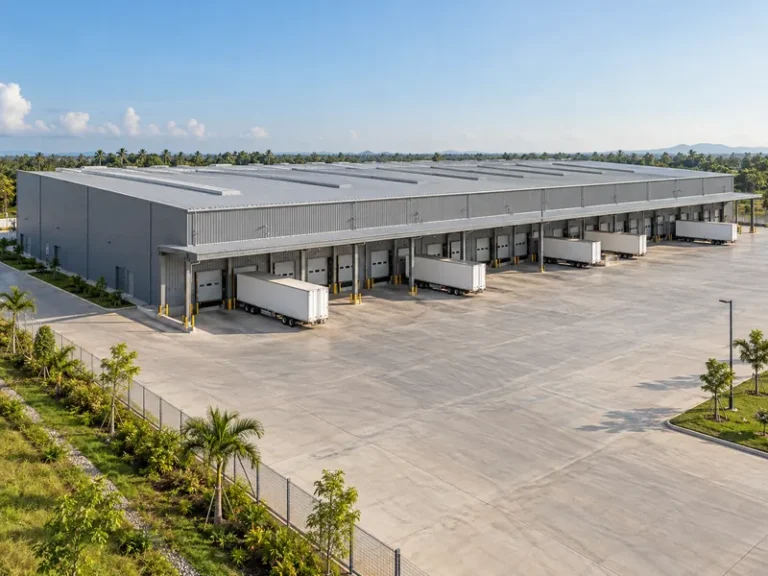
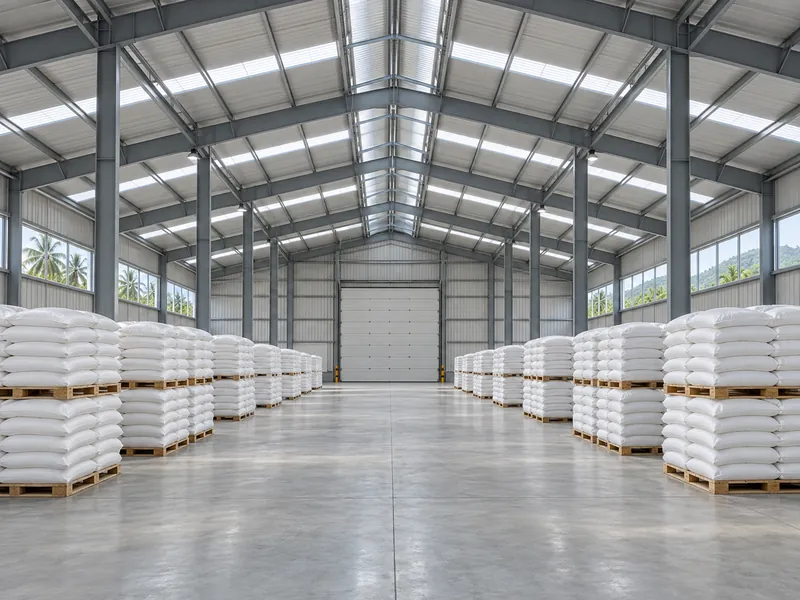
A fertilizer storage warehouse building in a humid climate has two jobs that pull against each other. In normal operation it must keep moist air away from the product; if ammonium nitrate is ever caught in a fire, it must vent combustion and decomposition gases quickly. Compared with warehouse steel buildings planned for dry packaged goods, a fertilizer store needs its doors, floor, envelope and frame coating rethought. The stored product absorbs water and can attack steel and concrete. How far those changes go depends on three things: which products are stored, whether they arrive in bags or in bulk, and which authority approves the building.
This guide covers the building shell, layout and interfaces for solid fertilizer stored in bags or in bulk. Liquid fertilizer tanks, explosives storage and construction prices, including steel warehouse construction cost, are outside its scope. Nor does it replace local fire and hazardous-materials approval in the country where the warehouse will stand.
How Stored Fertilizer Affects the Warehouse Building
The product list is the real design brief. Fertilizers differ in how readily they take up moisture, how they affect building materials, and whether they can decompose when heated. A building designed for “fertilizer” in general will be wrong for part of the stock.
Moisture uptake is the property most likely to shape a building in tropical and coastal markets. The draft East African code of practice DEAS 1166 (2023, written for bagged fertilizer) lists the critical relative humidity of common products at 30°C. Critical relative humidity is the air humidity at which a material starts absorbing moisture from the atmosphere. The lower the value, the more often local air is wet enough to dampen the product.
| Product (per DEAS 1166 draft, Table 1) | Critical relative humidity at 30°C |
|---|---|
| Calcium nitrate | 46.7% |
| Calcium ammonium nitrate | 55.6% |
| Ammonium nitrate | 59.4% |
| NPK (varies with formulation) | 70.0% |
| Urea | 75.2% |
| Ammonium sulphate | 79.2% |
| Diammonium phosphate / muriate of potash | 84.0% |
| Potassium sulphate | 96.6% |
Reading the table against site climate data shows how hard the envelope has to work. A calcium ammonium nitrate store in a port city with long humid seasons needs sealable doors and a serious look at dehumidification. A store holding only potassium sulphate faces far fewer hours above its threshold. The values are reference points for door and ventilation decisions. They are neither dehumidifier setpoints nor a safe line for steel. Corrosion research on chloride salts presented at the Electrochemical Society in 2015 found steel corroding well below the humidity at which those salts deliquesce. That study did not test fertilizer, but it argues against treating a product’s critical humidity as the point below which dusty steel is protected.
Corrosion is the second property, and it is closely tied to moisture. DEAS 1166 defines corrosive fertilizers as those that gradually destroy materials, especially in contact with water. Damp product, spilled granules and condensation on cold surfaces together raise the corrosion risk for exposed steel members, fasteners and concrete floors.
Heat sensitivity matters mainly for ammonium nitrate-based products. DEAS 1166 notes that these fertilizers may decompose slowly above about 130°C under fire or heat and give off dense, toxic fumes. That property drives the fire ventilation and separation questions covered further down.
Bagged and Bulk Fertilizer Storage Layouts
Bag-stack figures from published codes should not be carried over to bulk piles, because the two storage forms size and load the building differently. Grid, clear height and wall design follow the storage form first and the product second.
For bagged stock, the DEAS 1166 draft gives a usable starting layout. It recommends a 1 m haulage alleyway, at least 0.6 m between stacks and between stacks and walls, and wooden pallets that keep bags about 10 cm off the floor. Stack height is 4 m for its “hygroscopic, corrosive and explosive” group and 5 m for other fertilizers, with 0.6 m left between the top of the stack and the roof. The draft places urea and the superphosphates in that lower-height group alongside the nitrates. That heading is a stacking rule, not proof that every listed product has all three properties. The stack plan, alleys and roof clearance then give a first eave height and bay layout.
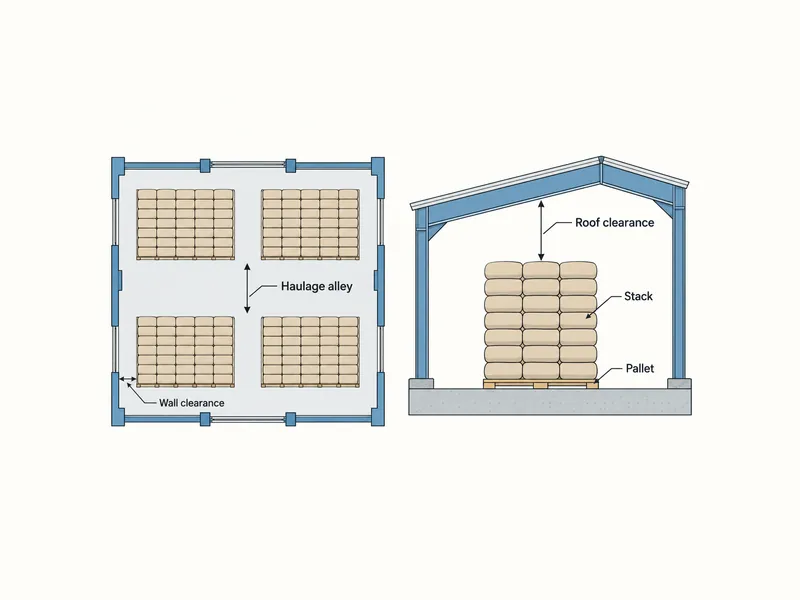
Bulk storage is governed by pile geometry, handling equipment and product behaviour. In the United States, OSHA’s ammonium nitrate standard requires that bulk ammonium nitrate never be piled higher at any point than 36 inches below the roof. It also limits pile height by the product’s tendency to set under pressure, which OSHA links to humidity, temperature and prill size. Piles that bear against walls, columns or bin partitions load them sideways. The structural engineer has to design those elements for pile pressure instead of treating them as ordinary cladding or a standard portal frame.
The unloading vehicle can also set clear height. One published US dry-fertilizer project, for example, sized its clear height to suit rear tilt trailers. A building size planner can give early planning dimensions for span, bay spacing and eave height. Engineered dimensions still come from the vehicle data and the structural design.
Moisture Control in the Fertilizer Warehouse Envelope
In humid markets, doors, floor and envelope decide whether hygroscopic stock stays dry; adding ventilation openings alone does not. The DEAS 1166 draft recommends keeping doors and ventilators closed during periods of high humidity and covering stacks of hygroscopic fertilizer. Under the draft, the building opens for free aeration only when outside humidity is not high. That operating pattern assumes a building that can actually be closed tight.
For hygroscopic products in a frequently opened store, the draft recommends an ante-room, a series of compartments, or two successive doors. It also calls dehumidification facilities ideal for large quantities held over long periods. Which openings need an ante-room or double doors depends on how often each is actually used. List the expected truck and personnel traffic, including any traffic through industrial steel building loading docks, before fixing the door layout.
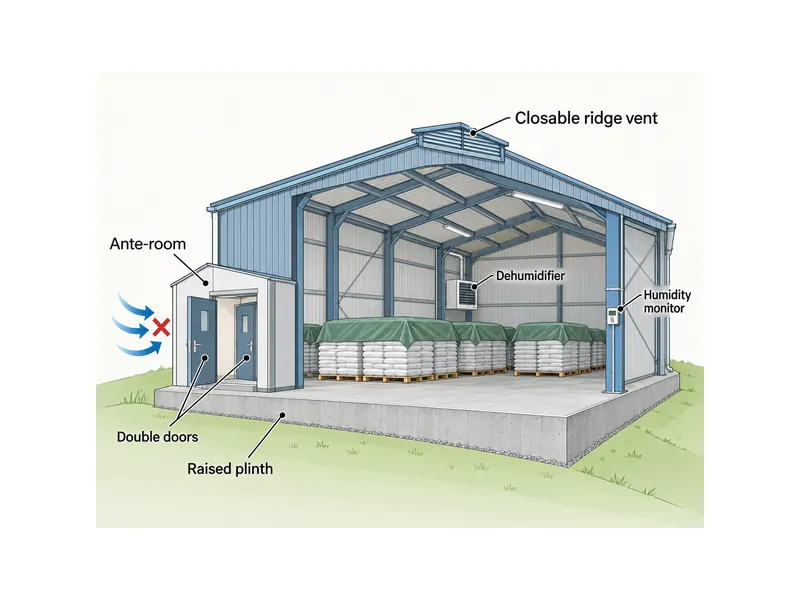
Floor and plinth details stop moisture from below. The draft calls for a concrete floor, a 1 m plinth where the water table is high or flooding is possible, and a protective coating where the product attacks concrete. It also suggests bitumen on the floor and the walls up to 0.5 m, because product bleeding from damaged bags attacks both. A New Mexico State University extension fact sheet for US farm-scale stores adds a grade sloping away from the building.
Condensation on the roof and walls is the moisture source that the shell itself creates. The DEAS draft observes that stores with low plinths and galvanized iron or cement sheet roofs show pronounced swings in temperature and humidity. A single-skin metal roof that cools below the dew point overnight can drip onto stock and wet the steel above it. A dew point check with an envelope and insulation selector helps compare roof and wall build-ups at planning stage. The result is a planning estimate, and project thermal design still has to follow.
DEAS 1166 also asks for temperature and humidity monitoring equipment on site. Readings compared with the critical humidity of the products in store show when doors must stay shut and whether dehumidification is keeping up.
Fire Ventilation for Ammonium Nitrate Storage
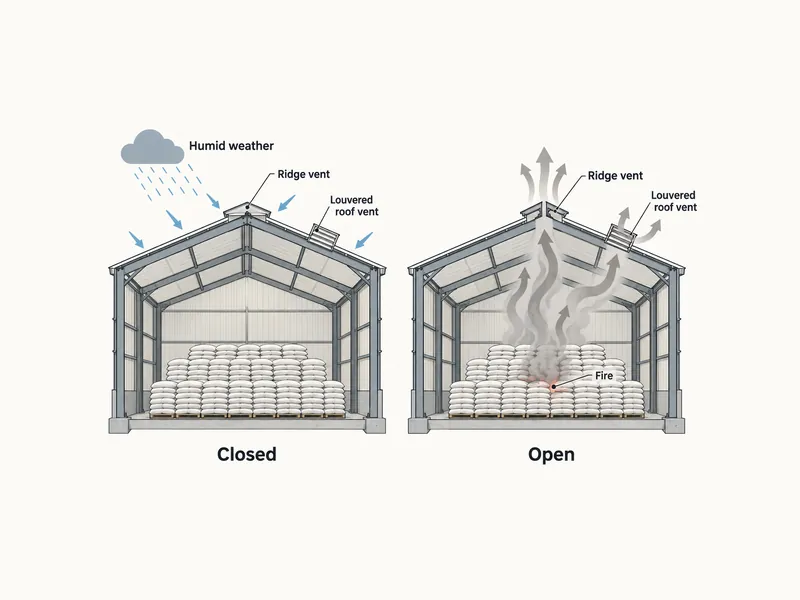
Ammonium nitrate adds a fire ventilation requirement that can work against moisture control. Daily operation wants a building that seals; a fire wants one that vents combustion and decomposition gases quickly, through the same roof and wall openings. Design both together and agree them with the approving authority early.
The US rule shows what “adequate” fire ventilation means in practice. OSHA’s standard 29 CFR 1910.109(i) requires ammonium nitrate warehouses to have adequate ventilation or be capable of adequate ventilation in case of fire. OSHA’s 2014 interpretation says the purpose is to remove combustion and decomposition gases. It lists manually operated vent fans, ridge vents and louvered roof vents as acceptable examples. OSHA does not consider ventilation designed only for worker comfort, reliance on open doors or windows, or floor-mounted fans adequate. Ridge or louvered vents that close in humid weather and open in a fire are one way to reconcile the two demands, provided the authority accepts the arrangement.
The same OSHA standard requires floors in ammonium nitrate storage to be noncombustible or protected against impregnation. It also bars open drains, traps, tunnels, pits or pockets into which molten ammonium nitrate could flow. Where a bulk plant uses unloading pits or conveyor tunnels, they have to sit outside the ammonium nitrate zone or be resolved with the authority before the foundation design is fixed.
Heat sources and separation shape the electrical and mechanical layout. The DEAS 1166 draft says fertilizer should not contact steam pipes, electric cables, motors or lighting, or be exposed to frictional heat from conveyors. It also recommends a separate warehouse, or at least a separate area, for hazardous nitrate-based fertilizers. Cable routes, light fittings and motor positions are therefore part of the building layout from the start.
Repairs to the steel structure carry their own fire risk. Under the draft, fertilizer must be removed or protected before cutting or welding, and the area watched for several hours afterwards. The owner, the designer and the local authority should therefore agree how frame and cladding repairs will be done while stock is in the building.
OSHA’s rule applies in the United States only. For warehouses in Africa, Southeast Asia, South America or Mexico, the local fire and hazardous-materials authority sets the requirements. There, the OSHA text is best used as a list of questions to raise. Vent areas, airflow rates and separation distances must come from the governing code and a qualified fire engineer.
Steel Frame and Corrosion Inputs for Fertilizer Storage
Steel is one of the three materials the DEAS 1166 draft lists for a permanent fertilizer store, alongside concrete and tile. The part that must change from a dry-goods warehouse is the corrosion specification. The corrosion designer needs inputs that a standard warehouse enquiry rarely includes.
The fertilizer-specific inputs are product type, storage form, interior humidity regime and where dust will settle. Bagged stock mainly exposes the lower walls and floor to spills and leaking bags. Bulk handling can also leave airborne dust on ledges, purlins and connection plates. Opening the building in humid weather then adds condensation to those dusty surfaces. OSHA’s ammonium nitrate guidance treats hardened accumulations in corners and on ledges as an inspection issue in their own right. Detailing with fewer horizontal dust traps is easier to keep clean. The corrosion designer then selects the coating system and exposure category using the general principles of corrosion protection for steel buildings, with the fertilizer exposure as the input.
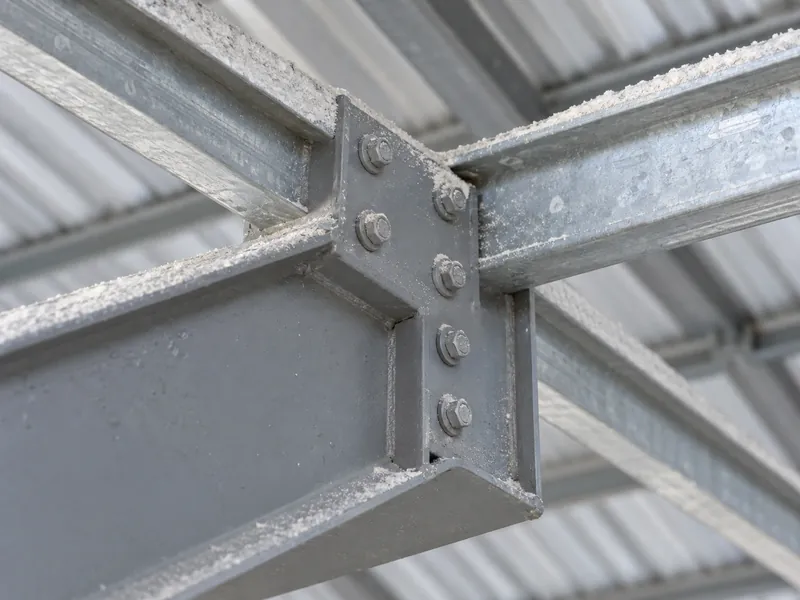
Product-contact surfaces need a separate check. For ammonium nitrate bins in the United States, OSHA’s interpretation says unprotected galvanized iron, aluminum, copper or zinc in bins may be cited. The guidance covers bin contact surfaces and does not address galvanized main frames. Even so, confirm the compatibility of any steel that touches the product.
Closed hollow sections need their own question to the supplier. Where trusses, bracing or columns use them, ask how their interiors are sealed, drained or protected against moisture and dust.
Design Inputs for a Fertilizer Storage Warehouse Building
A structure and envelope supplier can only design the right fertilizer store if the owner fixes the storage conditions first. These inputs come from the operator, the product suppliers and the local authority, not from the steel designer:
- Products and grades to be stored, including whether any are ammonium nitrate-based or have low critical humidity.
- Storage form: bagged, bulk or both, with a stack plan for bags or pile geometry for bulk.
- Handling equipment and vehicles, which set clear height, door sizes and any pits or tunnels.
- Site climate and ground data: humidity and temperature through the year, flood risk and water table.
- Humidity strategy: door operation in humid periods, ante-room or double doors, dehumidification and monitoring.
- Fire and separation requirements: separate building or zones, fire ventilation method, and floor and pit restrictions agreed with the authority.
The tender should also name who supplies each interface: frame, purlins, cladding and coating; fire ventilation; dust control; electrical layout; and the floor slab. The owner and designer need to confirm that split against every quotation. Checking each quote’s scope with a steel building buying guide helps reveal which of these interfaces nobody has priced.
Final Priorities for a Fertilizer Storage Building
Critical humidity, corrosiveness and heat sensitivity differ so widely between fertilizers that the product list has to come first. After that, moisture control and fire ventilation are two systems sharing the same openings, and a ventilated shed solves neither by default. The building that works in humid markets stays closed through wet periods, can still open its roof vents in a fire, and keeps ammonium nitrate away from pits, cables and hot work. Write the stored grades and their critical humidity values at the top of the warehouse brief before any frame or cladding is selected.
FAQ
Can urea be stored in a steel warehouse in a humid port?
Yes, provided the building can be closed and kept dry. The DEAS 1166 draft gives urea a critical relative humidity of about 75% at 30°C. Air in a humid port can stay above that for long periods. Sealable doors, an ante-room or double doors, humidity monitoring and a coating system specified for fertilizer exposure are the main design points.
Does ammonium nitrate need a separate building from other fertilizers?
Ammonium nitrate needs at least a clearly separated area, and a separate building where the governing code requires one. The DEAS 1166 draft prefers a separate warehouse for hazardous nitrate-based fertilizers. Where that is not possible, it accepts a separate area away from other stock and heat sources. The separation construction itself must come from the local fire authority.
How high can fertilizer bags be stacked in a warehouse?
Bag stack height depends on the product group and the code that applies on site. Under the DEAS 1166 draft, a group that includes the nitrates, urea and the superphosphates is limited to 4 m. Other fertilizers go to 5 m, and 0.6 m stays clear below the roof. Other jurisdictions use different figures.
What clear height does a bulk fertilizer storage warehouse building need?
No general figure applies. Clear height has to cover the pile, any roof clearance the code requires, and the raised body of the vehicles that tip inside the building. For ammonium nitrate in the United States, OSHA keeps piles at least 36 inches below the roof. Vehicle data from the operator and the structural design fix the final dimension.
Does stored fertilizer corrode a steel warehouse frame?
Stored fertilizer can corrode a steel frame, mainly where damp product, dust or condensation sit on exposed steel. Moisture and condensation are what turn fertilizer contact into a corrosion risk, so the humidity regime and the dust-prone surfaces are key inputs to the coating specification. Contact surfaces such as bin linings need a separate compatibility check for each product.
Are ridge vents enough ventilation for a fertilizer warehouse?
Ridge vents can be part of the answer if they serve both modes. For ammonium nitrate in the United States, OSHA lists ridge vents among acceptable examples of fire ventilation, while comfort ventilation or open doors do not qualify. For moisture control, the same vents must be closable during humid periods.
Further Reading
- OSHA: Guidance on the Ammonium Nitrate Storage Requirements in 29 CFR 1910.109(i) — U.S. Occupational Safety and Health Administration, standard interpretation. Explains fire ventilation, floor, pit and pile-height requirements for ammonium nitrate storage; applies to US workplaces only.
- DEAS 1166:2023 Code of Practice for Handling, Storage and Disposal of Bagged Fertilizers — East African Community draft standard. Source of the critical relative humidity table, stacking and warehouse construction recommendations; draft status and bagged-fertilizer scope.
- Reducing the Risk of Groundwater Contamination by Improving Fertilizer Storage and Handling — New Mexico State University Cooperative Extension fact sheet. Covers siting, impermeable floors and drainage for farm-scale fertilizer storage in the United States.