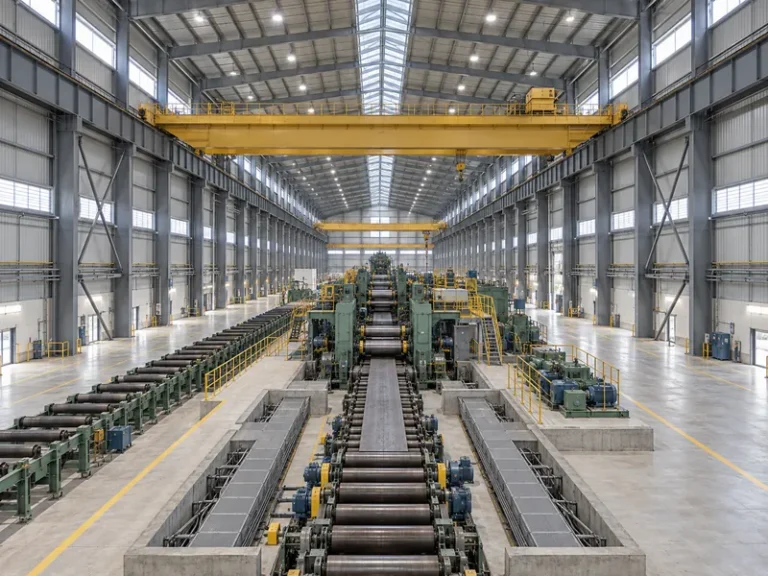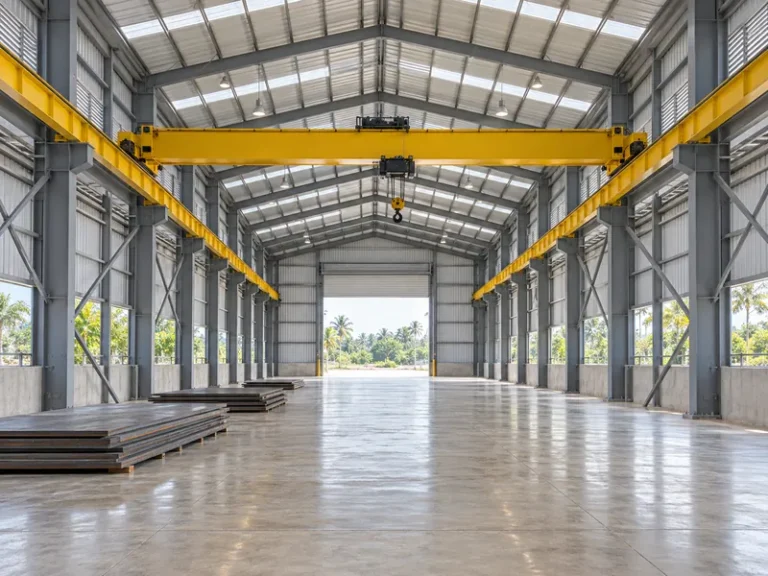
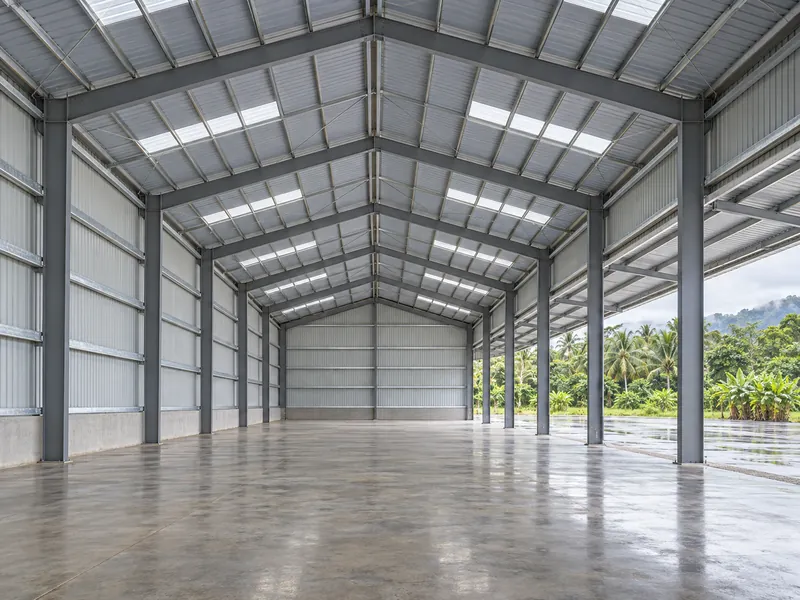
Industrial steel building corrosion protection works when each exposure zone and each member group gets its own specified system, not when one paint name and one total thickness cover the whole building. A dry, heated packing hall, a humid process area, an open-sided loading canopy and the roof sheeting above them can sit in different corrosivity categories under ISO 12944-2. For owners and contractors buying steel frame industrial buildings for sites in Africa, Southeast Asia or Latin America, the useful question is which zone each member sits in. Each zone then needs its own system, surface preparation and inspection record.
The scope here is atmospheric exposure of the primary frame, secondary members, cladding and fasteners. It does not cover immersed or buried steel, high-temperature process areas, or fire protection coatings, which need their own specification and a local engineer’s review.
Why One Coating Thickness Cannot Define Corrosion Protection
A total dry film thickness (DFT) on a quotation tells a buyer how much coating is planned, but not whether that coating suits the exposure. The same total number can describe very different systems: a single thick barrier coat, a three-coat zinc primer, epoxy and polyurethane build, or galvanizing with paint over it. Each behaves differently on cut edges, at welds and under ultraviolet light, and each needs a different surface preparation before it goes on.
Published standard systems make the gap easy to see. In the exterior building examples on steelconstruction.info, a C3 system uses an 80 µm zinc phosphate epoxy primer, 100 µm of epoxy MIO and a 60 µm site-applied polyurethane finish. A C4 example uses a 40 µm zinc-rich epoxy primer, 100 µm of epoxy MIO and a further 100 µm site-applied MIO coat. Both add up to about 240 µm, yet they are different systems written for different categories, so the total alone cannot tell a buyer which one fits the site.
Four further items sit outside any DFT figure and decide how the protection performs in service:
- The exposure zone of each area, which can differ between the inside and outside of the same building.
- The surface preparation grade and layer sequence that the chosen system’s data sheet requires.
- Detailing that lets water drain and lets maintenance crews reach every face.
- Protection of bolts, nuts and washers, which needs its own line in the specification.
Treat a coating proposal as complete only when it states all of these for each member group. A thickness figure is then one acceptance check inside that specification.
Corrosivity Categories for Industrial Building Interiors and Exteriors
The corrosivity category is the starting variable, because it sets which systems are even candidates. ISO 12944-2 grades atmospheres by how fast unprotected low-carbon steel loses thickness in its first year of exposure. The figures below are as tabulated on steelconstruction.info; losses may slow in later years, and the examples are typical rather than exhaustive.
| Category | First-year steel loss (µm) | Typical exterior | Typical interior |
|---|---|---|---|
| C1 very low | ≤ 1.3 | – | Heated buildings with clean air, such as offices and schools |
| C2 low | > 1.3 to 25 | Rural areas with low pollution | Unheated buildings where condensation can occur, such as depots |
| C3 medium | > 25 to 50 | Urban and industrial areas; coasts with low salinity | High-humidity production rooms, such as food processing, breweries and dairies |
| C4 high | > 50 to 80 | Industrial areas; coasts with moderate salinity | Chemical plants, swimming pools, coastal boatyards |
| C5 very high | > 80 to 200 | Humid industrial areas; coasts with high salinity | Areas with almost permanent condensation and high pollution |
| CX extreme | > 200 to 700 | Offshore; sub-tropical and tropical atmospheres | Industrial areas with extreme humidity |
Interior zones of an industrial building deserve their own classification instead of inheriting the exterior one. A high-humidity food line can reach C3 from its own process moisture, while a chemical store under the same roof can fall into C4. The same reference treats most interior C4 and C5 conditions as outside its standard tables and recommends specialist advice. That advice applies to areas such as fertilizer stores and livestock buildings with ammonia.
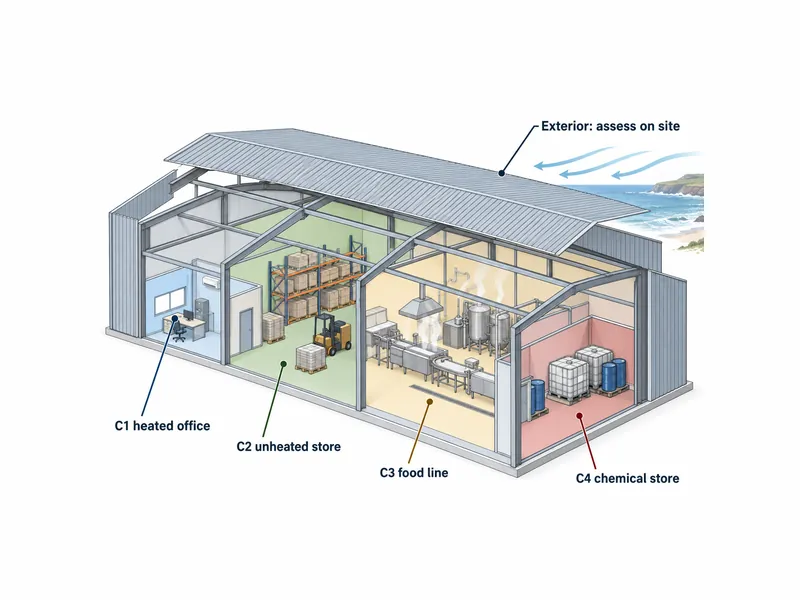
Warm, dry interiors sit at the other end of the scale, and steel there may need no corrosion coating at all. Steelconstruction.info states that in C1 conditions no corrosion coating is required for structural stability over the design life. Few industrial buildings are fully C1, though, because unheated storage halls where condensation can occur already fall into C2.
Two plants in the same city can sit in different exterior categories. Exposure to the shoreline, the prevailing wind and nearby emission sources are site conditions to check in a local corrosivity assessment, not distance rules to apply from a map. Ask the supplier to write the category of each zone into the specification, together with the basis for it. The project’s local engineer or coating specifier should confirm that basis.
Protection Methods for Frames, Cladding and Fasteners
The protection method should follow the member group as well as the category, since frames, secondary members, sheeting and fasteners are made and exposed differently. Primary members such as welded H-section portal frames are usually blast cleaned and shop painted. Purlins, girts and sheeting often arrive with a metallic coating from the mill or galvanizer. Zinc protects in two ways: it acts as a barrier, and at scratches it corrodes sacrificially in place of the steel.
| Method | How it protects | Where it tends to fit | What to confirm |
|---|---|---|---|
| Hot-dip galvanizing | Metallurgically bonded zinc; barrier plus sacrificial action | Secondary members, exposed frames, members hard to repaint | Vent and drain holes, tank size, distortion risk |
| Multi-coat paint system | Zinc-rich or zinc phosphate primer, epoxy build coat, UV-resistant finish | Primary frames in C2 to C4 zones | Blast grade, layer thicknesses, overcoat windows |
| Duplex (galvanizing plus paint) | Paint barrier over a sacrificial zinc layer | Coastal or humid exterior steel that also needs a colour finish | Sweep blast or etch primer before painting |
| Thermally sprayed zinc or aluminium | Sprayed metal layer, usually sealed and overcoated | Very high corrosivity zones and large members | Coarse grit blasting, sealer, higher cost |
Hot-dip galvanizing gives a thick, hard coating, but its thickness depends on the steel. Steelconstruction.info gives about 85 µm as the typical minimum average for structural steelwork. Thick sections and blast-cleaned steel tend toward thicker coatings of up to about 140 µm. Designers must also allow for filling, venting and draining, especially on hollow sections. The galvanizing decision therefore has to come before the detailer freezes the shop drawings for steel structure fabrication.
Duplex systems add a paint barrier to zinc’s sacrificial action, provided the fresh galvanizing is prepared so the paint can bond. Published guidance calls for a light sweep blast or an etch primer or “T-wash” before the paint system. Thermally sprayed aluminium, typically 100 to 200 µm, and sprayed zinc, typically 100 to 150 µm, are considerably more expensive than galvanizing. In the steelconstruction.info building tables, sprayed aluminium appears only among the C5 exterior examples, sealed and overcoated.
Roof sheeting and wall panels follow a separate route from the frame. Sheeting normally starts as metallic-coated, prepainted coil, so the coil’s coating grade and paint system define its protection, not a shop paint schedule. For coastal and humid sites, confirm the sheet’s metallic coating type and weight, the paint system on both faces and the fastener material as one package.
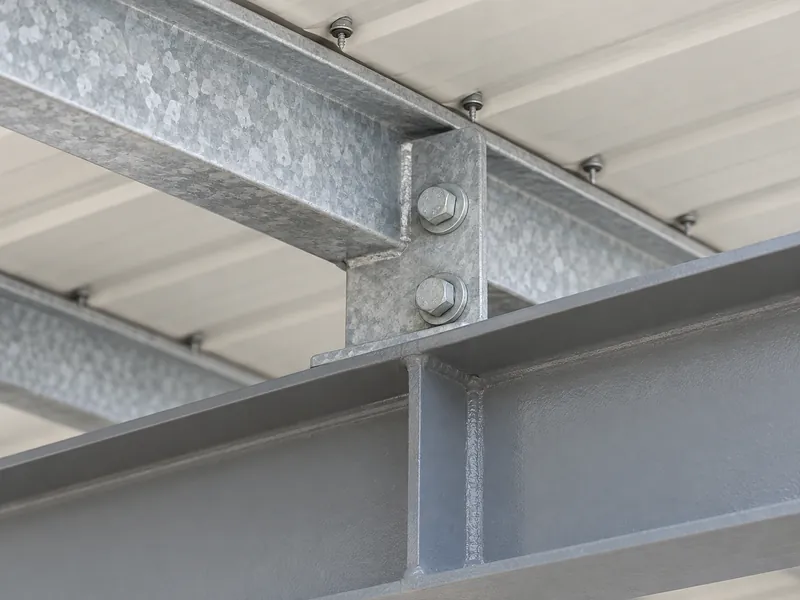
Fasteners deserve the same level of protection as the steel they join. Steelconstruction.info recommends that bolts, nuts and washers be protected at least to the level of the primary steelwork. Hot-dip galvanized fasteners carry a considerably thicker coating than electroplated or sherardized ones, and the same source advises applying the full coating system after assembling the bolted joint. Listing bolt heads, washers and the steel under them as separate touch-up items keeps them from being skipped during site painting.
Durability Ranges and First Major Maintenance Planning
Durability in ISO 12944 is a maintenance-planning estimate, not a warranty. Steelconstruction.info summarises the ISO 12944 durability ranges as low (under 7 years), medium (7 to 15 years), high (15 to 25 years) and very high (over 25 years). It describes durability as a considered estimate of life to first major maintenance that does not imply a warranty period. The estimate assumes regular inspection, prompt repair of minor defects and application by competent operatives.
Choosing a durability range is therefore a decision about when the owner expects to repaint. A building whose roof steel will be hard to reach once production equipment is installed may justify a higher durability range than an open warehouse that can be repainted between leases. In the steelconstruction.info exterior tables, coating life is the time until about 1% of the surface shows rust, so “first major maintenance” still means planned work.
Cranes, conveyors or ceiling services that block the frame after handover, whether in industrial crane buildings or other plants, force a choice about durability. The owner either accepts a shorter repaint cycle with difficult access, or specifies a more durable system up front. Neither choice is wrong, but the owner should write the trade-off down before suppliers price the coating.
Detailing Steel Members So the Coating Can Do Its Job
Details that hold water or cannot be coated properly undermine a coating system whatever its thickness. The design-for-corrosion guidance on steelconstruction.info refers to ISO 12944-3. Its general detailing rules apply to industrial frames as well as to bridges:
- Avoid narrow gaps, hard-to-reach corners and hidden surfaces that a spray gun or brush cannot reach.
- Orient channels and angles so they do not hold water, for example no channels with toes upward.
- Avoid lap joints and crevices, or seal them, because capillary action draws water in and causes crevice corrosion.
- Provide drainage holes where water can collect, and allow air to circulate so steel dries quickly.
- Insulate contact between dissimilar metals, and separate steel from timber and damp masonry.
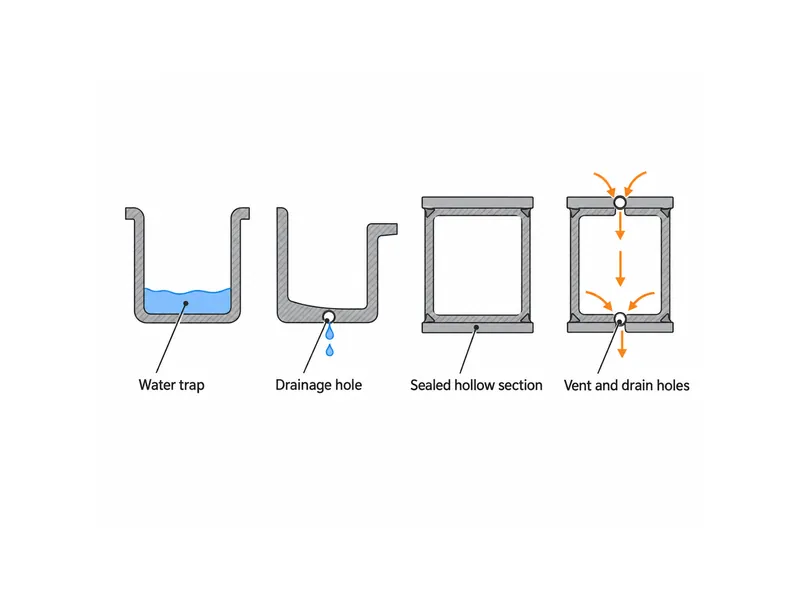
Hollow sections need a deliberate choice. Sealed hollow sections keep moisture out of the interior, while sections that will be hot-dip galvanized must instead be vented and drained so zinc can flow through. If one drawing set mixes both approaches without marking which members are galvanized, a sealed member can reach the galvanizer, or a vented member can be left open to moisture.
Field welds and cut edges need their own line in the specification. Shop coatings stop short of site weld zones, and edges carry less film than flat faces. The specification should name the touch-up system for site welds, cut edges and transport damage, and state that it must be compatible with the shop system.
Specifying and Accepting the Coating Scope on an Export Order
An export order needs the corrosion protection scope written per member group, because the steel is coated in one country, shipped, handled several times and erected in another. A clear scope also makes the quotation comparable between suppliers. Before awarding the order, a buyer can ask each supplier to confirm in writing:
- The corrosivity category assigned to each zone of the building, and the durability range targeted.
- The system for each member group (primary frame, purlins and girts, sheeting, fasteners), with each layer’s material and nominal DFT.
- The surface preparation grade to ISO 8501-1 that each system’s data sheet requires; in the steelconstruction.info example systems most paint systems use Sa 2½, while the sprayed aluminium example uses Sa 3.
- The inspection records to be supplied, such as DFT readings, adhesion test results and photographs, and the rule used to sample DFT readings.
- Who supplies touch-up material for transport damage and site welds, who applies it, and who inspects it after erection.
Factory DFT records are part of normal metal building quality control, but they only prove compliance if the buyer has agreed what the readings must meet. Inspection rules such as SSPC-PA2 define how many readings to take and how to judge low individual values. Adhesion checks commonly use cross-cut testing to ISO 2409 or pull-off testing to ISO 4624. The buyer and supplier should agree which rule and which test apply before production starts.
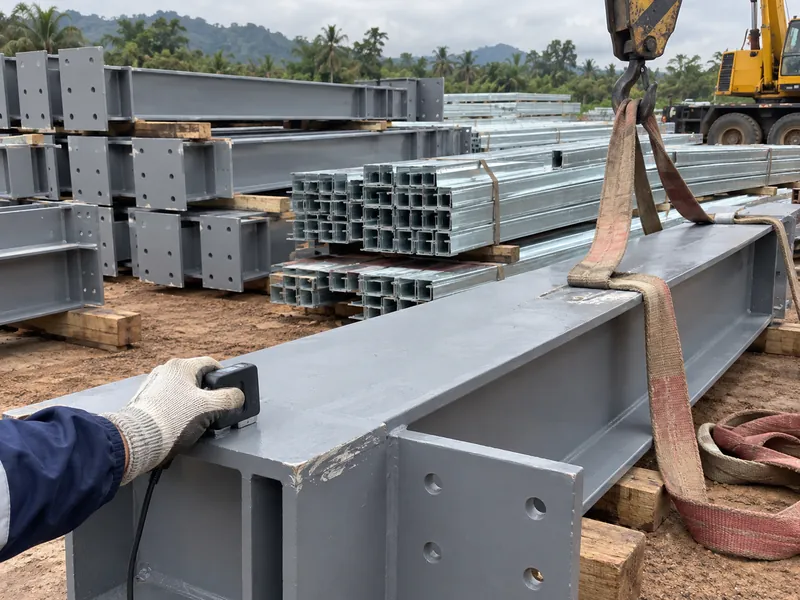
Arrival inspection should focus on the places that take contact during lifting, stacking and shipping: lifting points, member ends, bundle edges, and contact points between stacked members. Damage found at this stage is easier to repair on the ground than once members are bolted up at height. The agreed touch-up system should be on site before unloading starts.
Closing the Gaps Between Zones, Shop Coating and Site Work
A corrosion specification for industrial steel buildings can look complete in its main paint system and still leave the boundaries undefined. Those boundaries run between zones with different categories, between shop coating and site welds, and between the frame and its fasteners or sheeting. A buyer who fixes the category of each zone, the system for each member group and the touch-up responsibility before production closes the gaps that a single DFT figure hides.
Run the checks in a fixed order. Classify the zones first, then choose systems per member group, then confirm the detailing and inspection records, and only then compare thicknesses and industrial steel buildings prices between suppliers. Writing site weld and transport damage touch-up into the contract before steel leaves the factory keeps the specified system repairable on the schedule it was designed for.
FAQ
Does steel inside a dry, heated factory need a corrosion coating?
Steel in a warm, dry, clean C1 interior may need no corrosion coating for structural reasons. Few factories stay C1 throughout: unheated areas with condensation fall into C2, and humid or polluted process areas into C3 or above, so each zone still needs its own classification.
Is hot-dip galvanizing or paint better for a steel building near the coast?
Neither method is better in every case, and the answer depends on the corrosivity category and maintenance access at that site. Classify coastal exposure from the site’s actual conditions, not from a fixed distance to the shoreline. Galvanizing gives a tough sacrificial layer that suits members hard to repaint, while a multi-coat paint system allows colour and can be touched up on site with a compatible product. Duplex systems combine both, provided the galvanized surface is prepared before painting.
What corrosivity category applies to a fertilizer store in a humid tropical climate?
A fertilizer store in a humid tropical climate needs a specialist assessment, because a general table cannot set its category. The reference tables list sub-tropical and tropical atmospheres among the CX exterior examples, although a real site still needs its own classification. Interiors with heavy condensation, pollution or ammonia from stored material can fall into the interior C4 and C5 conditions that those tables refer to specialist advice. The local engineer or coating specifier should set the category for each zone before anyone chooses a system.
Should the primary frame and the cladding have different corrosion protection?
The primary frame and the cladding usually need different specifications because they are made and exposed differently. The frame is normally blast cleaned and shop painted or galvanized, while roof and wall sheeting arrives as metallic-coated, prepainted coil. Purlins, girts and fasteners form a third group with its own line in the specification.
How can a buyer check that delivered steel matches the coating specification?
A buyer can check delivered steel by comparing the supplier’s DFT and adhesion records with the agreed specification and then spot-checking thickness on arrival. Both parties should agree the sampling rule, such as SSPC-PA2, and the adhesion test method before production. Arrival checks should also cover transport damage at lifting points and member ends.
How many years before an industrial coating system needs major maintenance?
Time to first major maintenance depends on the durability range the system was designed for, from under 7 years to over 25 years in ISO 12944 terms. An owner can use that range to plan the first repaint budget. The figure assumes correct application and regular minor repairs and carries no warranty.
Further Reading
- Standard corrosion protection systems for buildings — steelconstruction.info, UK steel construction technical reference. Corrosivity categories with interior and exterior examples, and example systems for hidden, visible and exterior steel; examples are UK-based and need checking against local conditions and coating data sheets.
- Protective coating specification for bridges and steelwork — steelconstruction.info. How ISO 12944 corrosivity, durability ranges and surface preparation feed into a coating specification, and why durability is not a warranty period.
- Design influence on corrosion and protective detailing — steelconstruction.info. Detailing rules on water traps, crevices, drainage and dissimilar metals that let coatings be applied and maintained; some examples are bridge-specific.