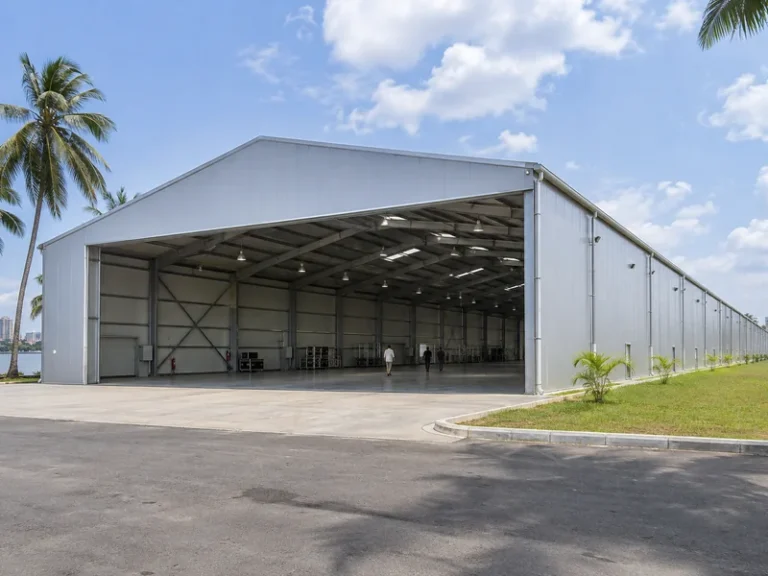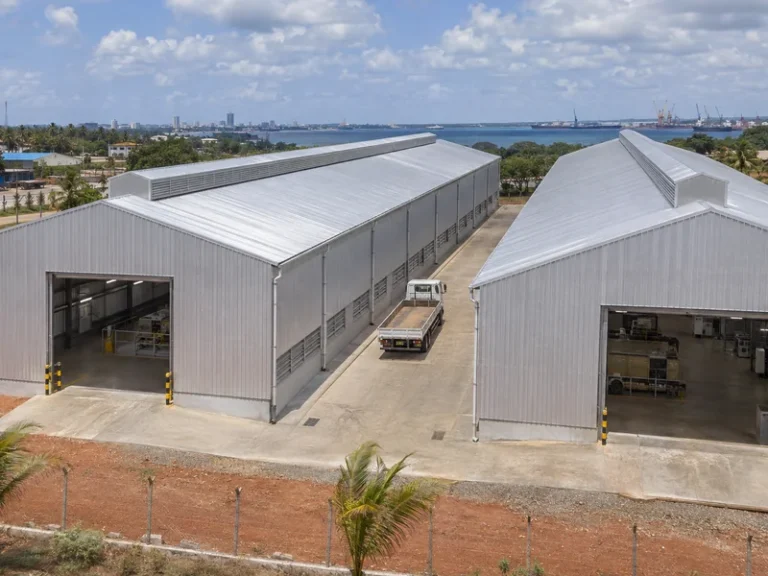
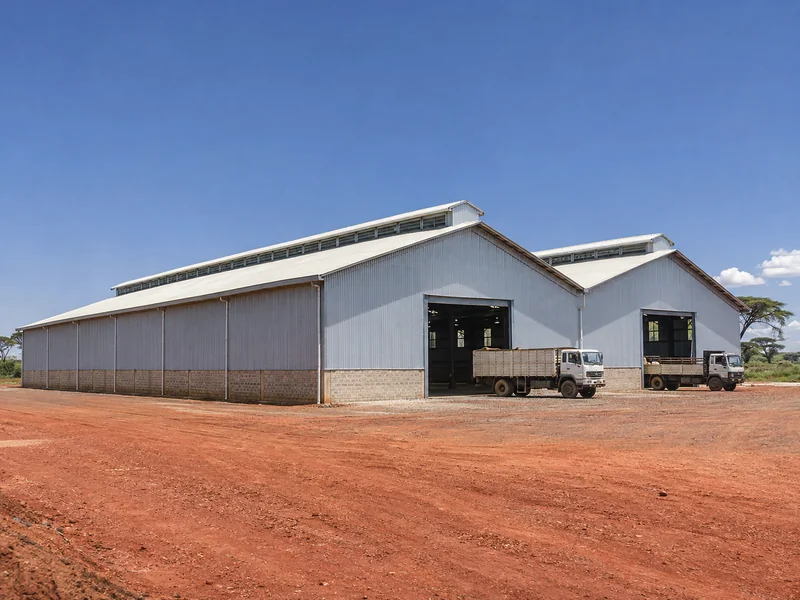
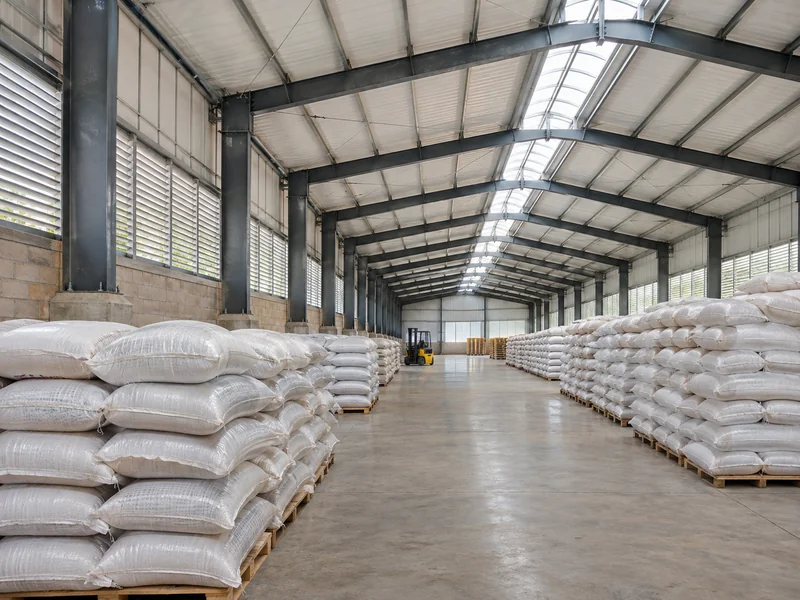
Stacked bags of sunflower and sesame can heat themselves from the inside. An oilseed buyer in Lira, Northern Uganda’s sunflower and sesame hub, answered that risk with this 50x100x8m agro-commodity steel warehouse in Uganda. Under the 36°C dry-season sun, a bare tin roof pours radiant heat onto the stacks below. The brief was 5,000 m² of cover that limits solar heat gain and provides a continuous outlet for warm air. A 50 mm PU roof, a 2.4 m-throat ridge vent and insect-screened wall louvers drive that cooling loop with zero fans. A 1.5 m masonry plinth closes the lower perimeter against rodents. Urgent-priority fabrication finished in 38 days ex works, and the shed was handed over on October 30, 2025, ahead of peak year-end buying.
| Project Parameter | Project Specification |
|---|---|
| Client Sector & Region | Oilseed buyer consolidating sunflower seed, sesame and soybean; Lira Agro-Industrial Zone, Northern Uganda |
| Building & Footprint | 50 m × 100 m × 8 m eave; 2 × 25 m spans; 5,000 m² single story |
| Frame & Coating | Q355B alkyd-epoxy coated H-beams; Z275 galvanized purlins & bracing |
| Envelope & Ventilation | 50 mm closed-cell PU anti-sweat roof panels; 0.55 mm Aluzinc walls & ridge monitor; continuous 2.4 m-throat ridge vent; insect-screened wall louvers |
| Base Interface | Column base plates flush atop 1.5 m reinforced masonry moisture-and-rodent plinth (plinth by local team) |
| Design Loads & Codes | 120 km/h convective gusts, heavy rain; Uganda US EAS / BS EN 1993 |
| Lead Time & Handover | 72-hour shop drawings; 38-day urgent-priority fabrication (EXW); handover October 30, 2025 |
| Shipment & Route | 184 tons in 9 × 40’HQ axle-compliant containers ex Port of Qingdao; CIP Lira via Mombasa–Tororo Corridor |
Why Bagged Sunflower and Sesame Heat Under Tin
Oilseeds are living cargo: whole sunflower, sesame and soybean seeds respire in storage, and respiration gives off heat. In a dense bag stack, heat dissipates slowly, so warm pockets can grow inside the pile. Moisture migrates toward cooler layers, and the stock can slide toward spontaneous heating and caking. No spark or machine fault is needed, because the commodity itself is the heat source.
The buyer’s reference point was the neighboring tin-roofed godowns. Under equatorial sun, bare single-skin sheeting radiates onto the upper stack layers all afternoon. Bagged oilseeds shed internal heat slowly, so daytime gain stays trapped in the pile overnight. Rapid night-sky cooling can chill the bare tin below the indoor dew point, so condensation forms and drips onto the surface bags. A few wall openings do not fix this, because warm air stagnates under the ridge unless a continuous high-level exit lets it leave.
Lira’s climate compounds that thermal load. Dry-season heat reaches 36°C, then sudden convective thunderstorms arrive with heavy rain. Ventilation openings must breathe all day yet keep driven rain and insects out. Ground damp and rodents, meanwhile, threaten the perimeter base. The envelope had to answer heat, storms and ground moisture in one design.
PU Roof and 2.4m Ridge Throat Venting Without Power
The roof and wall envelope pairs insulation with buoyancy ventilation, so warm air keeps clearing whenever the pile zone is warmer than the outside air.
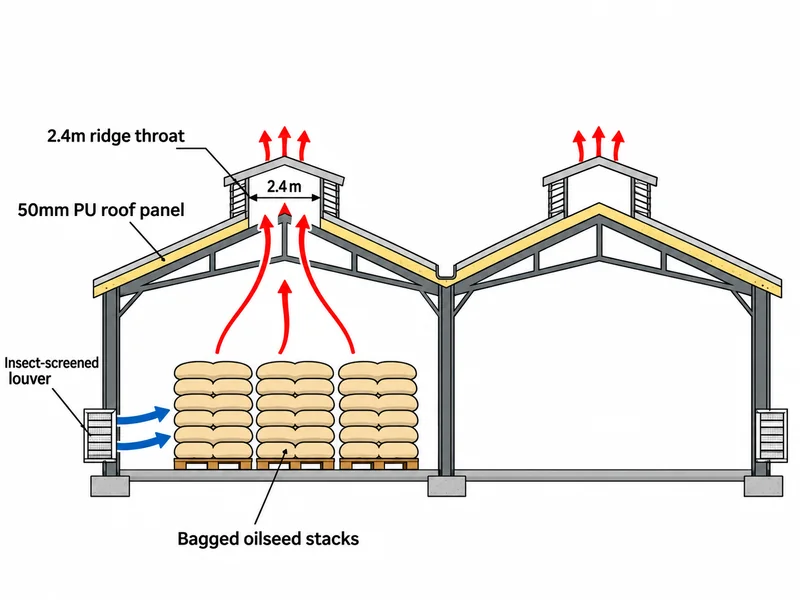
- Block heat at the roof: the roof uses 50 mm closed-cell PU anti-sweat sandwich panels. The insulated core throttles conductive heat gain from the sun-heated outer sheet, limiting radiant heat transfer from the inner skin onto the bags. At night, the insulation keeps the inner skin warmer than bare sheeting would be. That lowers condensation risk, though condensation can still form if the inner skin reaches the indoor dew point. The closed-cell structure resists moisture uptake through the humid season.
- Give warm air a continuous exit: a ridge monitor with a continuous 2.4 m-throat vent runs along the roof. The throat stays open day and night, so buoyant air from the seed piles can vent at any hour. The monitor geometry shields the opening from driven rain.
- Feed the chimney from below: insect-screened louvers sit in the lower cladding above the 1.5 m plinth. They admit make-up air across the aisles through insect screens.
Together these three elements form a passive chimney with no moving parts. There are no fans, no motors and no grid connection in the ventilation path. The stack effect runs whenever air above the stacks is warmer than outside air at the louvers. Walls are 0.55 mm Aluzinc cladding, matched to the ridge monitor profile.
Bolted Portals on a 1.5m Moisture-and-Rodent Plinth
Twin 25 m clear spans divide the 50 m width, and the bolted portal layout runs 100 m long at an 8 m eave height. Main members are Q355B welded H-beams, shot-blasted to Sa2.5 and finished with an alkyd-epoxy coating; purlins and bracing are Z275 galvanized sections. We sized the frame for 120 km/h convective gusts and heavy rain under Uganda US EAS and BS EN 1993.
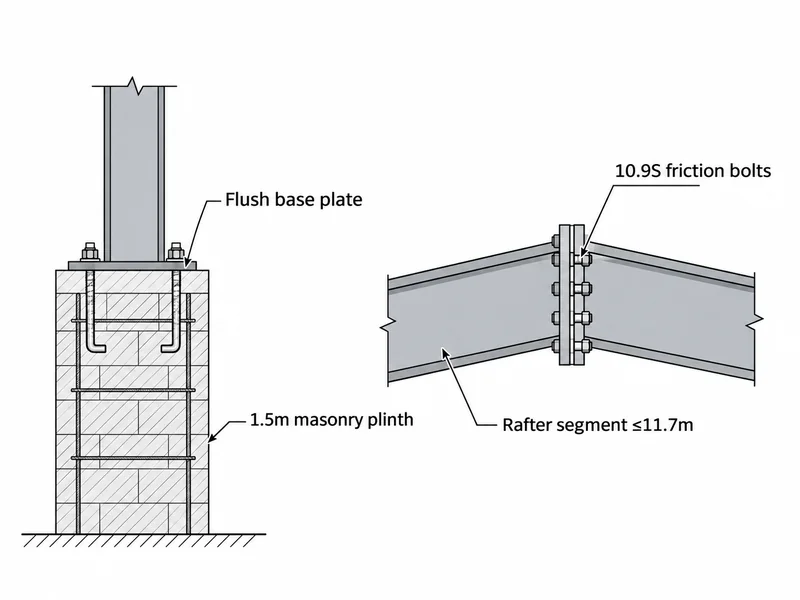
Every rafter ships in segments no longer than 11.7 m, so each piece fits a standard 40’HQ container. Prefabricated end plates and 10.9S high-strength friction bolts join the segments on site. The whole frame erects with zero field welding, and bolted splices let a local crew assemble the 100 m length bay by bay.
At the perimeter base, column base plates were detailed to sit flush atop a 1.5 m reinforced masonry moisture-and-rodent plinth wall. That solid lower wall shields the lower cladding from storm splashback. It also eliminates the grade-level corrugation gaps where rodents would enter under thin cladding. The local team built the foundations and the plinth; our scope was the base-plate interface detailing and the Tekla erection drawings their crew followed. Inside, each 25 m span gives a column-free band for bag stacking and truck movement, the same floor logic used in flat grain storage buildings.
38-Day EXW Rush and Nine Containers to Lira
The buyer had asked for an urgent quote and fast-track delivery ahead of year-end crop buying. The shed had to be weather-tight before oilseed intake began in Lira.
The shop drawings cleared fast-track detailing in 72 hours. Once the buyer signed off on the Tekla 3D model, our Pingdu, Qingdao plant released the Q355B plates to the cutting line. Urgent-priority fabrication then completed the steel package in 38 days ex works. That figure is strictly the factory manufacturing cycle; ocean and inland transit follow on top of it.
Primary and secondary steel were bundled onto custom steel pallets, and the 184-ton shipment was packed into nine 40’HQ containers with individual loading plans. Each box averaged about 20.4 tons, loaded axle-compliant for the East African road leg. Dispatched from the Port of Qingdao under CIP Lira terms, the consignment crossed by sea to Mombasa and cleared transit customs there. Trucks then hauled the boxes along the Tororo corridor into Lira, the standard sea-road chain for landlocked Uganda.
Local crews erected the bolted frame from our Tekla drawings, with import duties, final clearance and local permits on the buyer’s side. The warehouse was closed in on October 30, 2025, ahead of peak buying. The shed took in the year-end sunflower and sesame intake and then worked through the 2026 rains.
The PU roof and passive ridge ventilation were intended to limit heat buildup around the bag stacks during seasonal intake.
Which Sites Can Reuse This Passive Oilseed Shed
This envelope configuration suits bagged oilseed and grain consolidation hubs in hot climates with convective storm seasons. It fits sites that want cooling with no electrical dependency, and owners who buy in seasonal waves and need fast covered capacity. The twin-span footprint extends by adding bays along the length.
- Whole-shed gas fumigation: an open 2.4 m ridge vent rules out full-building gas dosing. Under-sheet stack fumigation on the floor needs a separate sealing assessment. If your protocol needs total-enclosure dosing, specify a sealable envelope with dampered vents.
- Chilled or frozen chains: this shed manages heat, not refrigeration. Temperature-controlled commodities need an insulated cold-store system.
- Wet intake: the envelope limits solar heat gain and vents heat, but it does not dry the commodity. Oilseeds or grain above safe storage moisture still need drying before bagging.
Send your site dimensions, commodity list, planned stack heights and local wind and rain data, and we will engineer the frame, roof and vent throat to match. Bolted portal frames allow steel warehouse buildings to be assembled bay by bay.